NSE · BSE · MCX · Currency · Mutual funds
The market is real. The money is virtual. The discipline is yours.
Akechi Trade is a market-intelligence terminal and paper-trading platform for Indian markets. Trade live prices with virtual money, pay every simulated rupee of real-world charges, and build your process under an institutional-grade risk engine — with AI research that a human analyst must approve before anyone sees it.
Akechi Trade Terminal
SIMULATED DATA- +0.60%
NIFTY 50
24,812.40
- +0.25%
BANKNIFTY
51,204.15
- +0.61%
RELIANCE
2,931.55
- Five market segments: NSE, BSE, MCX, currency derivatives, mutual funds
- Built on Microsoft Azure and Azure Databricks
- Money is integer paise in code and storage — never a float (CL-002)
- Capability claims trace to code and CI checks in our repository (CL-001)
Why practice
Losing real money is the default way to learn trading.
Tips channels sell certainty. Hindsight gurus sell yesterday. Most simulators sell fills at prices you would never have got. None of them teach the thing that matters: a process — entries you can explain, exits you planned, costs you counted, risk you sized before you clicked.
Practice on the live market — honestly.
A sandbox is only useful if it refuses to flatter you. Ours is built to behave like the real thing, including the parts that hurt:
Fills that cost what fills cost
Orders walk the book and pay market impact; ticks round against you; an order outside the trading session or the circuit band is refused, not filled. (CL-003)
Every rupee of charges
Brokerage, STT or CTT, exchange transaction charges, SEBI fee, stamp duty, GST — computed to the paisa by the same engine our backtester uses, so the two can never disagree. (CL-004)
A risk engine that doesn't bluff
Eleven pre-trade checks that report which of them actually ran, session-scoped loss breakers, VaR that refuses to print a number it cannot compute, and limits you can only tighten mid-session. (CL-005)
Simulated results using virtual money on live market data. Simulated performance does not guarantee actual results.
The workspace
One terminal, first week to power user.
The Command Center is a dockable workspace: arrange panels, save the layout, and link chart, chain and depth into groups that follow one symbol together. Below 1024 pixels the same panels recompose into Simplicity Mode — one registry, two compositions, nothing dumbed down. (CL-027)
Linked panels
Assign panels to group A, B or C and a symbol change in one flows to the rest — the chart, the option chain and the depth ladder stay on the same story.
Ctrl-K for everything
One palette for navigation, symbols and actions, keyboard-complete. A recognised order phrase pre-fills the ticket for your review.
Voice that cannot submit
The voice grammar's output has prefill fields and no submit — “buy 10 Reliance” fills a ticket you still have to confirm. That is a property of the parser's type, not a setting.
Live market data
The feed you can afford to trust.
Real-time WebSocket fan-out with the honesty stated per tier — including the Free tier's delay, which we treat as a disclosure, not a secret. (CL-028)
Free is honestly delayed
Fifteen-minute delayed quotes, said twice: a badge in the interface and a watermark drawn onto the chart canvas itself — because a badge you can crop out of a screenshot is not a disclosure.
One socket per browser
A shared worker owns the connection; every tab subscribes through it. Ten tabs cost one socket — and count once against your subscription limit.
Paint now, tick after
Subscribing delivers the last known values immediately, then the stream takes over. No panel sits empty waiting for the next trade to happen.
Depth by tier
Five-level order book on Pro, the top-20 book on Elite — conflated to a steady cadence so a fast market stays readable.
Charts & indicators
The alert fires on the line you saw.
Thirty indicators are declared once, in one canonical spec. The chart's Web Worker, the alert engine, and the backtester each implement that spec — and a CI test computes all three and fails if any two disagree. An alert on a Supertrend(10, 3) flip fires on exactly the line the chart drew. (CL-006)
- Trend
- SMA, EMA, WMA, HMA, Supertrend, Ichimoku, PSAR, ADX
- Momentum
- RSI, MACD, Stochastic, CCI, Williams %R, ROC, TRIX, Aroon
- Volatility & bands
- ATR, Bollinger, Keltner, Donchian, StdDev
- Volume & flow
- VWAP, OBV, MFI, CMF
- Market structure (server-side)
- Max Pain, PCR, IV percentile, volume profile, delivery %
The options desk
A chain that shows its work.
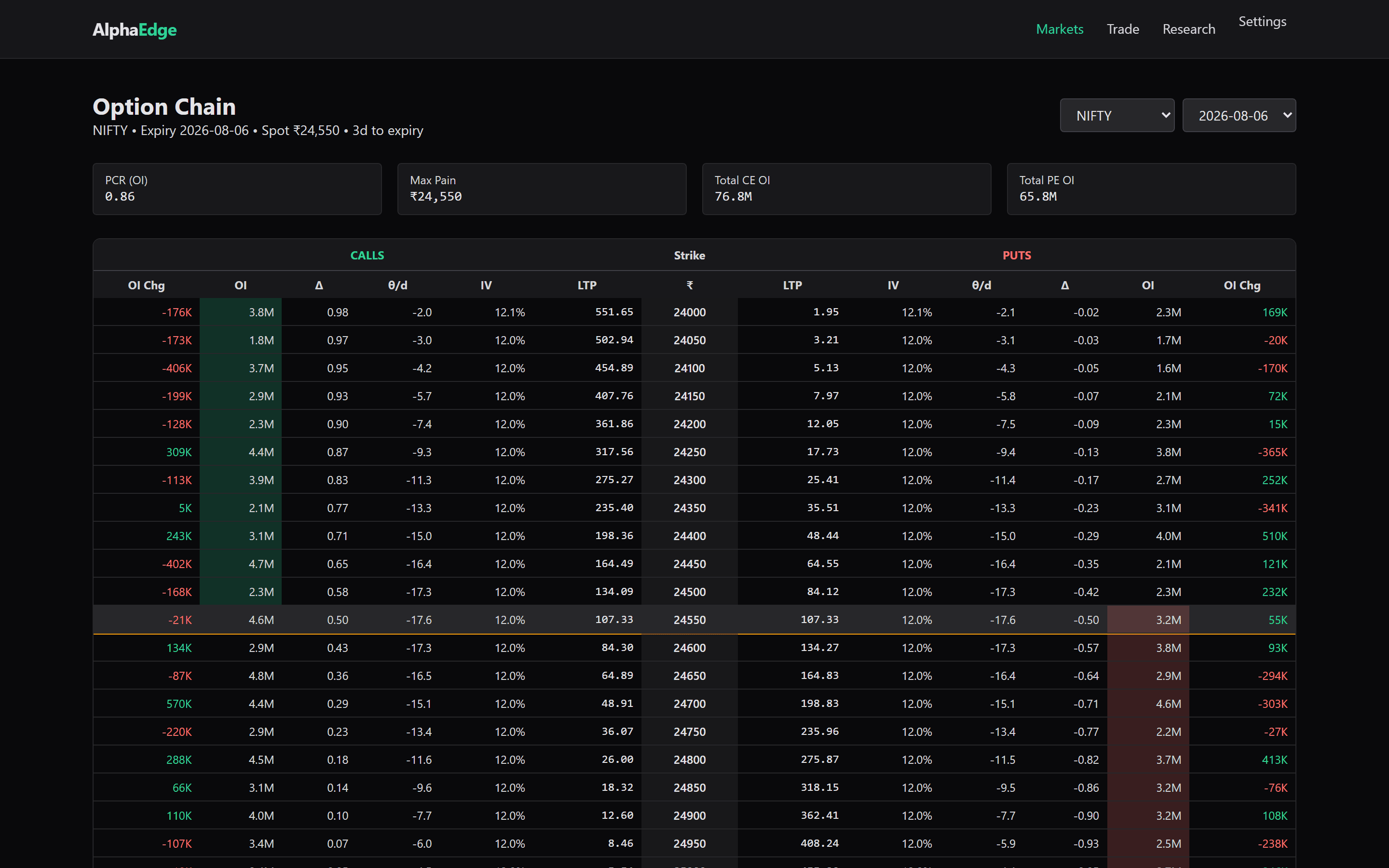
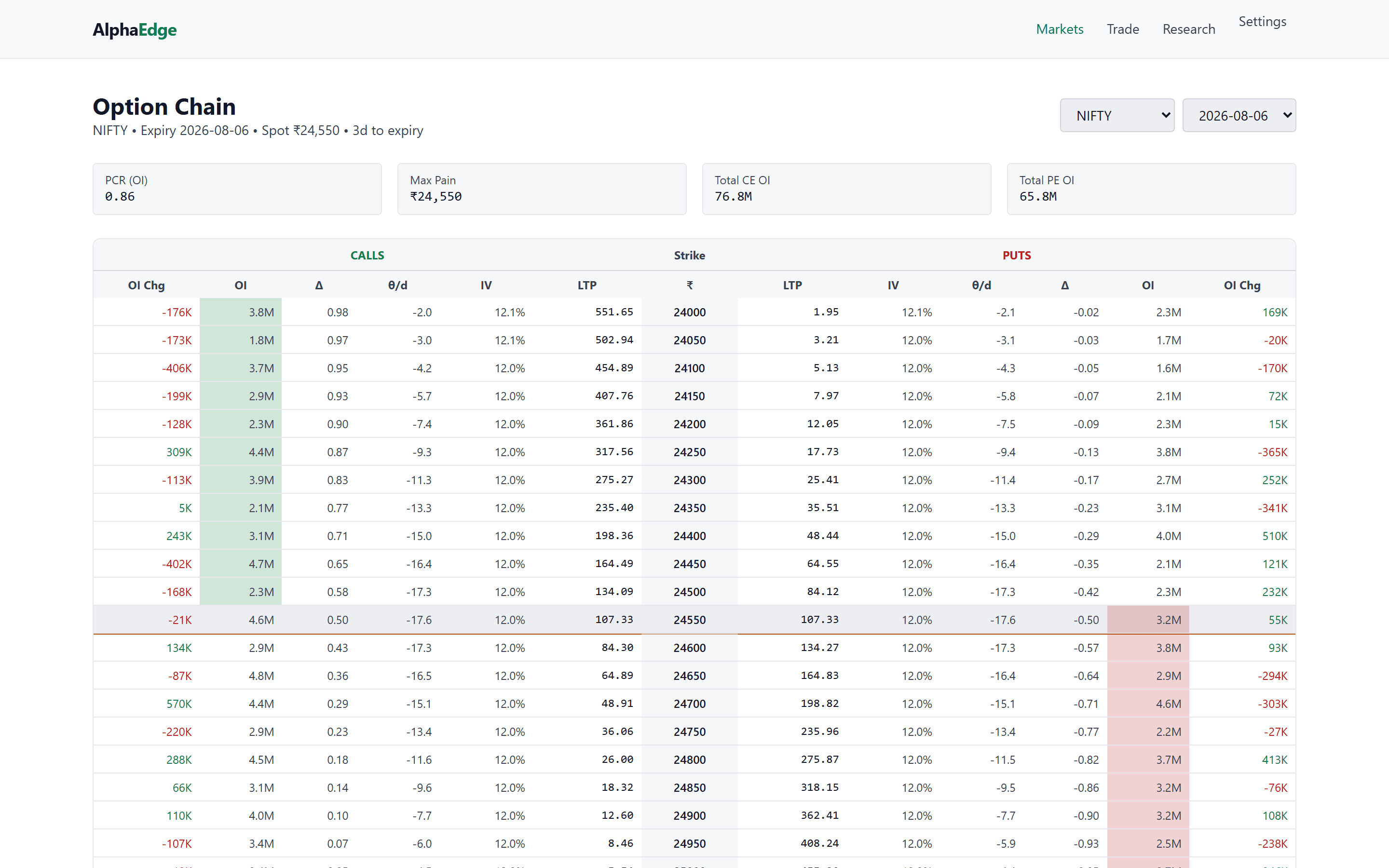
Every strike priced with Black-76 implied volatility and Greeks, PCR by OI and by volume, Max Pain, and OI build-up shading — one computation serving every viewer. On your own book, unpriceable legs are named and excluded, never written as zeros: a zero delta beside a real holding would be a claim of no exposure.
Jargon, decoded
The sandbox engine
Every rupee of the real cost stack.
The sandbox charges the full Indian stack on every executed order — computed by the same engine the backtester and the ML cost controls import, so no two surfaces can disagree to the paisa. Here is one ₹1,00,000 intraday round trip, computed by that engine: (CL-004)
| Charge | Buy | Sell |
|---|---|---|
| Brokerage | ₹20.00 | ₹20.00 |
| STT | ₹0.00 | ₹25.00 |
| Exchange transaction | ₹2.97 | ₹2.97 |
| SEBI fee | ₹0.10 | ₹0.10 |
| Stamp duty | ₹3.00 | ₹0.00 |
| GST | ₹4.15 | ₹4.15 |
| Round trip total | ₹82.44 | |
Illustration computed by packages/charges at build time — FY26 rate schedule, NSE equity intraday (MIS), ₹1,00,000 notional per side. When rates change, this table is regenerated, never edited.
MCX commodities pay CTT, not STT — a different statute and a separate contract-note line — and agricultural contracts are CTT-exempt. The engine models all of it, with real lot sizes: one CRUDEOIL lot is 100 barrels, and turnover math that forgets that is wrong by 100×.
Jargon, decoded
Risk management
A risk engine that tells you what it didn't check.
Before an order is accepted, eleven evaluations run — and the response reports each one as passed, warned, or explicitly skipped with its reason. A check that did not run is not a check that passed. (CL-005)
Eleven evaluations per order
Kill switch, daily and weekly loss breakers, order size, instrument and sector concentration, gross exposure, margin utilisation, open-order runaway guard, the exchange circuit band, and a portfolio heat warning.
Exits are never blocked
Reduce-only orders are exempt from our own limits. You are never trapped in a losing position by the policy that exists to protect you.
VaR that refuses to guess
A book without enough return history gets a refusal with the reason — never ₹0, the most dangerous number a risk page could print. Symbols it cannot cover are named, with the exposure behind them.
Limits you can only tighten
Mid-session, your own limits move one way: down. A limit you could raise at the moment you most want it gone is not a limit.
Jargon, decoded
Automation where it's safe
Trade management that works while your laptop is closed.
Sandbox positions are managed server-side — and every rule below emits alerts and sandbox orders only. What it takes to reach a real broker is the four-gate story further down. (CL-019)
Stops that only ratchet
Trailing stops in three modes — ATR, percent, Supertrend — that move one way. The tighten-only rule is a code path, not a promise: a widening amendment is simply never written.
Regime-aware, floored
When volatility regime shifts, stop parameters adapt — but never below the stop you started with. The floor is your initial risk, clamped in code.
Invalidation exits on bar close
Every setup carries the condition that falsifies it. When the bar closes against that condition, the position exits — holding and hoping is not a state the machine has.
Warnings that name the exposure
R-progress alerts as a trade crosses risk milestones, and correlation warnings in plain words — “Bank Nifty down 0.8% — your HDFCBANK long is exposed.” Events, never commands.
AI research
Five analysts, one human gate.
The daily pre-market report is produced like a desk, not a chatbot — and it cannot reach you without a named, registered human approving it. (CL-007) Research publication awaits our SEBI Research Analyst registration: the pipeline below runs today; publication stays gated until then.
Readiness gate
Six data probes run first. Missing core data aborts the run; a degraded feed drops its sections and caps conviction.
Five analysts
Technical, fundamental, sentiment, sector and quant specialists independently score a screened universe.
Deterministic fusion
Conviction is computed by code from the panel's scores. The model never assigns its own conviction.
CIO sizing
Risk-first position sizing — quarter-Kelly, capped at 10% per stock and 30% per sector.
Blocking compliance lint
Banned language, stops on the correct side, targets in order, risk-reward recomputed, maximum loss always defined.
Human approval
A registered research analyst approves, vetoes, or drops calls. Publishing without that approval is not possible in the system.
Audit chain
Every step lands on a hash-linked, append-only record before anything is served. (CL-010)
Scored, either way
Every published call is followed to its exit and scored net of the full charge stack — losers included.
Transparency
A track record no one can edit.
When publication begins, every call's outcome is measured by replaying it through the same state machine that tracked it live: hit rate over triggered calls with a 95% confidence interval, net of charges, broken down by setup and by conviction, published monthly under a content hash anchored to the audit record. Corrections attach; nothing is deleted. (CL-010)
Status today: dark launch.
The pipeline is accumulating its evidence window and nothing is published — which is why this site shows no performance figures at all. When the record exists, it appears here. Whatever it says.
Past performance is not indicative of future results. These are the measured outcomes of AI-generated research calls, net of simulated Indian trading charges, reviewed by a SEBI Registered Research Analyst. They are published for transparency and are not a promise, projection, or guarantee of returns. Investment in securities market are subject to market risks.
AI that knows its limits
“Should I buy?” is refused before the model runs.
The assistant answers from published research and curated education, or it declines. A deterministic classifier runs ahead of the model, so a personal-advice question costs no tokens and gets no improvisation — and every answer and every refusal lands on a hash-chained audit log with its id shown under the reply. There are no buy or sell buttons in a chat transcript; acting is always a separate, explicit step. (CL-026)
I can't answer that one, because it asks what you should do. Akechi Trade exists to publish research, not to advise individuals — whether a trade suits you depends on your objectives, your finances and your risk tolerance, none of which I know or am permitted to assess. What I can do is show you what the published research says about a symbol, including its levels, its assumptions and what would invalidate it, or explain how something works so you can judge it yourself.
AI-generated analysis, not a recommendation and not investment advice. This answer is general in nature, is not personalised to your circumstances, and may be incomplete or wrong. It has not been reviewed by a Research Analyst. Securities markets are subject to market risks.
Strategy Lab
Your backtest will try to lie to you. Ours isn't allowed to.
The Lab treats a flattering result as a bug. Every run pays the full charge stack, and the validation stack exists to take your best number away from you until it has earned publication. (CL-008)
Walk-forward, with an embargo
Parameters fit on one window are tested on the next, with an embargo gap between them — the out-of-sample stitches are the only part of the curve we take seriously.
Deflated Sharpe & plateau
The Sharpe ratio is corrected for how many variants you tried, and a parameter-plateau check asks whether neighbours of your best configuration also work — or whether you found a spike of luck.
Ten thousand Monte-Carlo paths
Trade order is resampled to a drawdown distribution, so you meet the losing streak your strategy contains before the market introduces you.
Watermarks you cannot dismiss
A result that hasn't passed out-of-sample, cost, Deflated-Sharpe and trade-count gates renders with a non-dismissable watermark. The gate is the feature.
Jargon, decoded
Hypothetical backtested performance. Results are simulated on historical data, have inherent limitations, and do not represent actual trading or guarantee future results. Not investment advice. Securities markets are subject to market risks.
Know thyself
A journal that answers the questions you'd rather not ask.
Every sandbox trade is journaled automatically and honestly: entries and exits tagged by what the order actually did to your position, wins and losses counted net of charges, forced exits marked with their reason, hold times left blank when unknowable — never zero. Emotions come from a closed vocabulary, so “do I lose money when I'm impatient?” stops being rhetorical. (CL-022)
The leaderboard is opt-in, pseudonymous, and hard to game
Names are HMAC pseudonyms, the benchmark is the NIFTY 50 total-return index, and no one appears without twenty closed trades and thirty active days. Withdraw consent and the very next read excludes you. (CL-023)
Jargon, decoded
Coverage
Five segments, one desk.
NSE and BSE equities and derivatives, MCX commodities with real contract lot math, currency derivatives, and AMFI mutual funds with SIP tracking — in one terminal, under one risk engine.
IT
▲ +0.82%
Banks
▼ −0.34%
Auto
▲ +0.51%
Pharma
▲ +0.12%
FMCG
▼ −0.08%
Metals
▼ −0.61%
Energy
▲ +0.27%
Realty
▲ +1.04%
Graduate to live
When you're ready for a real broker: four gates.
Paper is the product; live is the graduation. A real order can only leave Akechi Trade through four gates, checked together so none can be skipped — and each refusal names the gate that stopped it. (CL-009)
Deployment flag
Live trading is off by default in every deployment. The admin console can display the switch; it cannot flip it.
Versioned consent
You consent to specific wording. If the wording changes, prior consent is invalid and you are asked again.
Step-up authentication
A fresh second factor with a fifteen-minute lifetime. Recent is the point.
Your confirmation, every order
No automated live orders, ever. The confirmation defaults to absent, so an integration that forgets to ask is refused.
Zerodha Kite is the first adapter, built broker-agnostic. Your broker password has nowhere to live in our system — the session model has no field for one, and a scanner refuses any payload that carries one.
Your data, your rules
Security posture, stated plainly.
The full page states what exists, what is planned, and what we refuse to build — here is the shape of it.
No broker passwords, by construction
The broker-session model has no field a password could occupy, and a scanner refuses any payload carrying one. (CL-009)
Broker tokens envelope-encrypted
AES-256-GCM under a Key Vault key, bound to their database row, with rotation built in — and production refuses to boot with the dev cipher. (CL-031)
Sessions time out server-side
Thirty minutes idle and the session is revoked at the server — not a client timer a stale tab forgets to run. (CL-029)
Staff are not users
Staff authenticate against a separate directory, and the role that publishes research is not the role that operates the platform. (CL-030)
India-only, private by default
Infrastructure checks refuse non-India regions and public network access — 52 of them, on every change. (CL-013)
Four hash-chained audit logs
Research, risk, billing and AI chat each write an append-only chain whose integrity is re-verified on read. (CL-017)
How it's built
Built like it has to be right.
The honesty on this page is not a tone of voice; it is enforced. These numbers describe the codebase, and the checks behind them run on every change.
49 bytes
The tick wire contract
Producer and consumer share one struct; CI pins the exact bytes of a golden frame. (CL-011)
Verified in code & CI
30
Indicators, one spec
Chart, alerts and backtester compared by a drift gate on every change. (CL-006)
Verified in code & CI
11
Pre-trade risk evaluations
Each reports passed, warned, or skipped-with-reason. (CL-005)
Verified in code & CI
52
Infrastructure checks
India-only regions, private network access, audit-before-publish ordering, a deploy freeze on trading days. (CL-013)
Verified in code & CI
8
Adversarial researcher failures
Injected on every CI run — banned language, hallucinated tickers, wrong-side stops. All eight must be caught. (CL-015)
Verified in code & CI
4
Hash-chained audit logs
Research, risk, billing and AI chat — integrity re-verified on every read. (CL-017)
Verified in code & CI
And the rest of the desk.
Three more modules with the same rule applied: everything here exists today, and every sentence has a receipt in our claims ledger.
Alerts & watchlists
Thirteen alert conditions — price, volume, open interest, RSI, MACD and Supertrend crossings — indicator rules evaluated on bar close, delivered to verified contacts only. Quiet hours exist, and never mute a trailing stop-loss or an invalidation exit. (CL-021)
Mutual funds & SIPs
AMFI NAVs with honest gaps, SIP allotment the forward-looking way units are actually allotted — never a nearby NAV substituted — and an XIRR that returns nothing rather than a guess. (CL-024)
Institutional rails
API keys hashed at rest with two active slots so rotation has no downtime, webhooks signed with timestamped HMAC and a retry ladder that ends, and organisation seats whose offboarding revokes the member's keys in the same call. (CL-025)
What we will not do
The platform enforces these in code, and continuous-integration checks keep them true. They are the product.
- Promise returns, in any wording. Ever.
- Auto-trade your live broker account. Every real order requires your explicit confirmation — that line is what keeps this outside SEBI's retail algo perimeter, and it is not negotiable. (CL-009)
- Delete a bad research call. Corrections attach to the published record; nothing is rewritten and nothing disappears. (CL-010)
- Show you a number we did not compute. When data is missing, the screen says so — an empty panel is never dressed up as a quiet market.
Fair questions
Asked the way people actually ask them.
Will Akechi Trade make me money?
We will never tell you that — not because a regulator says so (though one does), but because nobody can honestly promise it. What Akechi Trade offers is practice on the live market with virtual money, real costs, and a risk engine — and, once research publication begins, measured outcomes net of charges with confidence intervals, losers included.
Is this investment advice?
No. Research features are informational, carry their disclaimers, and are gated by human analyst review before publication. The AI analyst refuses personal-advice framing — 'should I buy' never even reaches the model.
Can I trade with real money on Akechi Trade?
The sandbox is virtual money only. A live broker connection exists as a separate, gated path: off by default, versioned consent, step-up authentication, and your manual confirmation on every single order. There is no automated live trading, by design.
Which brokers are supported?
Zerodha Kite first, through an adapter architecture built for more. We never see or store your broker password — the system has no field it could live in.
What does the Free tier include?
The full sandbox on 15-minute delayed data, with the complete charge stack modelled, two watchlists and three alerts. It is not a trial and it does not expire.
Is my data safe?
Data stays in Indian cloud regions (DPDP Act 2023). Consent is recorded per purpose and versioned to the exact wording you agreed to; you can export your data or erase it from within the product.
Can a beginner use this?
Yes — Simplicity Mode composes the same panels into a simpler layout, the AI analyst answers education questions from a curated corpus, and the journal is built to show you your own patterns.
Why can't I see any performance numbers?
Because there is nothing honest to show yet. Research publication requires SEBI Research Analyst registration and a human review gate; until both are in place, nothing is published — here or in the product. When the measured record exists, it appears, whatever it says.
Learn the discipline before it costs you.
The Free tier is a full sandbox on delayed data with honest charges — free, no card required. Paid tiers add real-time data, depth, research and the Strategy Lab.